Mission systems that operate when networks fail
Tactical operations cannot wait for connectivity. Spectro Cloud delivers autonomous, secure infrastructure that functions reliably in contested, denied, intermittent, and limited (DDIL) environments—and synchronizes safely when networks return.
The mission requirement
Modern warfighting depends on distributed sensors, edge analytics, command and control systems, and autonomous platforms operating across austere and contested environments. From forward-deployed units to maritime vessels, from unmanned systems to expeditionary command posts, these missions share a common challenge: they cannot depend on persistent connectivity to centralized infrastructure.
Most cloud-native platforms fail this test. They assume reliable networks, centralized control planes, and continuous access to artifact registries and policy servers. When connectivity is denied or degraded, these systems stop functioning, require manual intervention, or lose the ability to update and adapt to changing threats.
Why this matters now
Near-peer adversaries have demonstrated the capability and intent to deny, degrade, and disrupt communications in contested theaters. GPS jamming, electronic warfare, and cyber attacks on satellite communications are no longer hypothetical—they are expected conditions in future conflicts.
At the same time, the is accelerating deployment of AI-enabled ISR, autonomous systems, and multi-domain command and control capabilities. These technologies generate massive amounts of data at the edge and require local processing, decision-making, and action—often without the luxury of reaching back to centralized cloud infrastructure.
.png)
The challenge
Traditional infrastructure platforms break down in DDIL environments. Kubernetes distributions that rely on external control planes cannot deploy or update clusters without connectivity. Container registries, policy servers, and certificate authorities become single points of failure. And operators are forced to travel to remote locations for hands-on maintenance, burning time and exposing personnel to unnecessary risk.
Even platforms marketed for "edge" deployments often require frequent connectivity for health checks, telemetry, and license validation. Configuration drift becomes unmanageable. Security posture degrades. And mission systems become fragile precisely when they need to be most resilient.
How Spectro Cloud solves this
Spectro Cloud is purpose-built for disconnected-first operations. Clusters operate autonomously without persistent network access, maintain security and compliance posture, and reconcile changes safely when connectivity returns.
Autonomous cluster operations
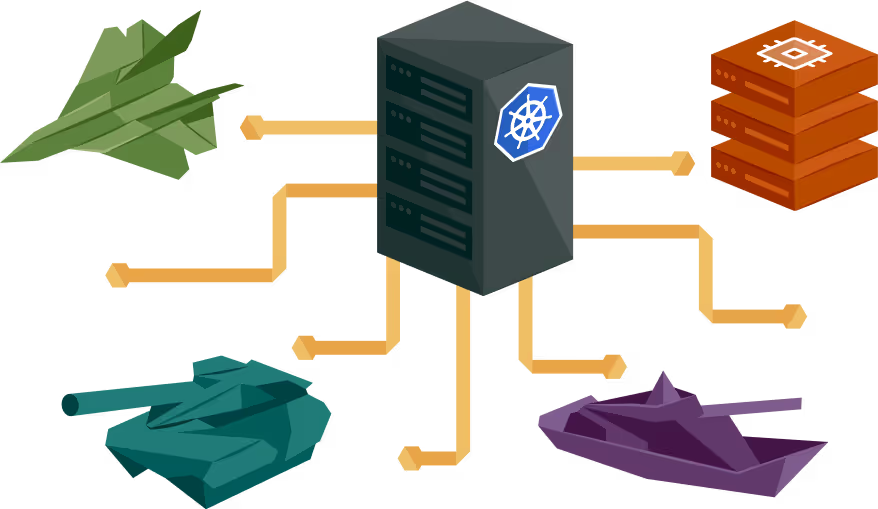
Every cluster runs independently with cached policies, local artifact registries, and embedded lifecycle management. Workloads continue executing, containers restart, and systems self-heal without reaching back to centralized control planes or external services.
.svg)
Delayed reconciliation
Configuration changes, updates, and policy adjustments are queued when networks are unavailable. When connectivity returns—whether through satellite uplink, tactical data link, or physical media transfer—changes synchronize automatically without manual intervention or operator access.

Immutable infrastructure reduces sustainment burden
Declarative configuration and immutable OS images eliminate configuration drift. Operators do not need to SSH into remote systems for troubleshooting or patching. Infrastructure becomes predictable and repeatable, even in environments where hands-on access is impossible or dangerous.

Edge-to-cloud data federation
When connectivity is available, edge clusters can feed telemetry, sensor data, and mission logs to centralized cloud environments for correlation, AI model training, and cross-domain analytics—while maintaining operational autonomy when networks fail.
.svg)
Mission outcomes you can measure
Continued operations under contested conditions
Mission systems maintain functionality during network outages, satellite denial, and electronic warfare. Sensors continue collecting data. Analytics continue processing. Applications continue executing. The mission does not stop when the network fails.

Reduced forward logistics burden
Fewer personnel required for infrastructure maintenance and troubleshooting. Less travel to remote sites. Lower operational costs. Reduced exposure of personnel to hostile environments.

Faster adaptation to changing threats
Software updates, security patches, and configuration changes deploy without physical access. New capabilities reach forward-deployed units in days instead of weeks or months.

Increased mission assurance
Immutable infrastructure and automated drift detection ensure systems remain in known-good states. Operators can verify integrity even in disconnected environments. Security posture does not degrade when networks fail.
.svg)
.png)


Ready to deploy infrastructure that operates anywhere?
Schedule a technical briefing to discuss your edge computing and tactical deployment requirements.
Frequently asked questions
Indefinitely. Clusters are designed to run autonomously for extended periods using cached policies and local artifacts. There is no forced check-in requirement or time-based license validation that would cause systems to fail when disconnected.
Clusters reconcile pending changes automatically using a secure synchronization protocol. Operators review proposed updates, approve changes, and deploy them without manual intervention or hands-on access to remote systems.
Yes. Updates can be delivered via physical media (USB, removable drives, or one-way data transfer systems) and applied locally. This supports operations in air-gapped, classified, or denied environments where network access is unavailable or untrusted.
Immutable OS images and declarative configuration mean patches are deployed as complete image replacements rather than incremental updates. This eliminates drift and ensures systems move from one known-good state to another without intermediate failure modes.
We support x86 and ARM architectures on bare metal, virtual machines, and ruggedized edge devices. Minimum footprint can be as small as a single node for constrained environments, scaling up to multi-node clusters for mobile command posts and forward operating bases.
All artifacts are cryptographically signed and verified at runtime. Encrypted storage protects data at rest. Zero-trust networking principles ensure workloads cannot communicate without explicit policy. And tamper detection alerts operators to unauthorized changes even when disconnected.
Yes. Our platform integrates with standard military communication systems including SATCOM, Link 16, and Joint Range Extension protocols. We support bandwidth-constrained synchronization and priority-based data transfer for contested communications environments.
Encrypted storage and remote attestation capabilities enable operators to verify system integrity and remotely disable compromised devices. Immutable infrastructure limits the persistence of adversary access, and declarative configuration enables rapid reconstitution of clean systems.
Book a demo of Palette VerteX
See how Palette VerteX can help you. Book a 30-minute demo with one of our experts.