One platform,from metal to tokens
PaletteAI is how enterprises, neo cloud and sovereign cloud providers, and regulated industries teams design, deploy, and manage VMs, Kubernetes, and AI workloads at scale — across clouds, data centers, and the edge.


Your whole estate, centrally managed
Platform and infrastructure teams are now faced with the complexity of managing Kubernetes across clouds and in a data center, continuing to run VMs, and maintaining GPU nodes that cost more than the rest of the estate combined.
PaletteAI puts all of it under one central management plane. Describe what an environment should look like — OS, Kubernetes, networking, storage, applications, AI stack — as a declarative profile. PaletteAI builds it, keeps it that way, and repeats it identically, whether you run ten clusters or thousands.
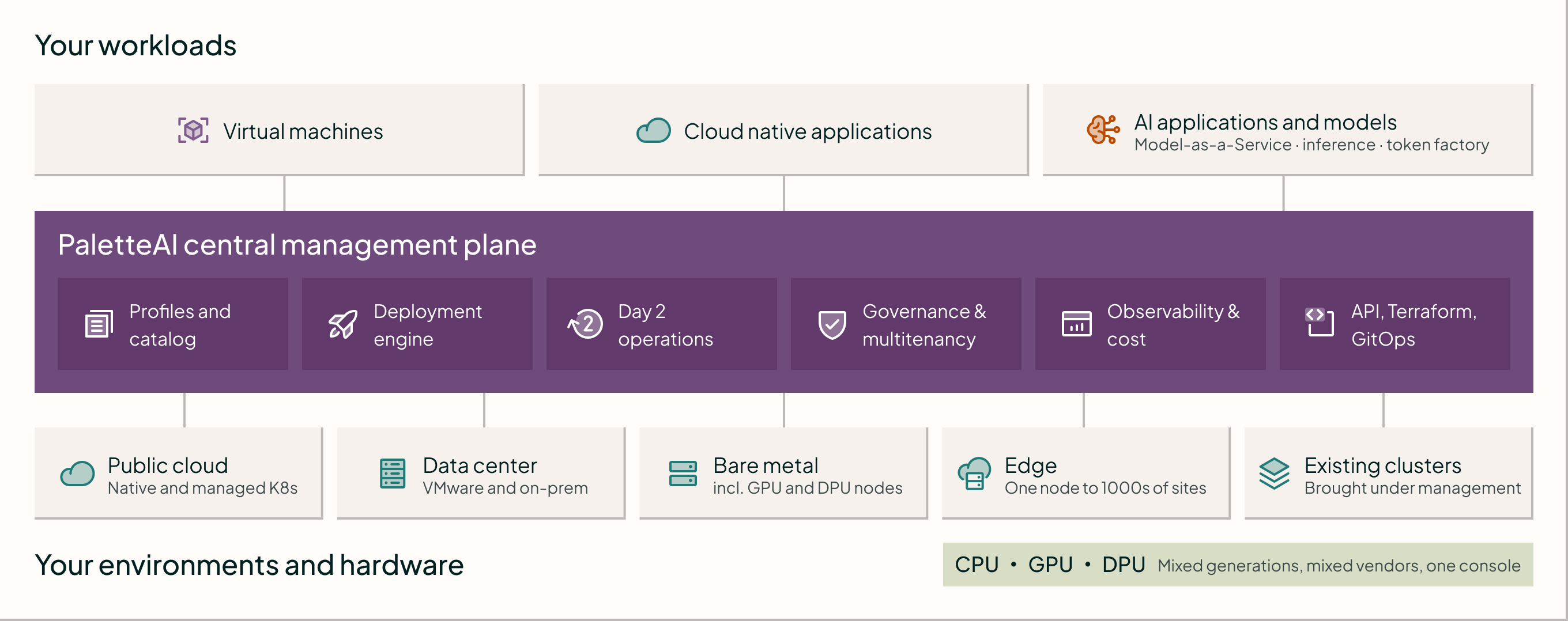
One control point for clusters, infrastructure, and the workloads on top - wherever they run.
The full lifecycle, from design to operations
Four stages, one loop — and all of it native to the platform.
Declarative blueprint stacks
Cluster Profiles are versioned blueprints for everything in a cluster: OS, Kubernetes distribution, networking, storage, add-ons, applications. Profile Bundles package complete AI stacks the same way — infrastructure plus applications like Run:ai and ClearML, ready to deploy repeatably. Start from the curated catalog in PaletteAI Studio, tune it, or bring your own.
Define once, deploy anywhere
Point a profile at a target and go: public cloud, managed Kubernetes, VMware, bare metal, or edge devices in the field. Create new clusters or bring existing ones under management. PaletteAI discovers hardware — including GPUs — provisions the full stack, and gives your teams self-service within the guardrails you set.
Make day 2 boring
The real work starts after deployment. Edit a profile and every cluster running it flags the change; approve it, and the rollout happens in parallel with zero-downtime upgrades. Backup and restore, OS patching, health alerts pushed to Slack or ServiceNow, and self-healing are built in. GE HealthCare patched 100 clusters this way.
Freedom for teams, control for you
Multitenancy is native. Tenants and projects isolate teams; quotas cap what each can consume, including GPUs; granular RBAC controls who touches what, down to individual profiles. Scheduled scans validate clusters against CIS benchmarks, run penetration and conformance tests, and generate SBOMs your auditors can use.
Containers, VMs, and AI, side by side
One platform for the workloads you have — and the ones the board just announced.
Virtual
machines
Run VMs next to containers on the same clusters, with VM orchestration built in. One inventory, one lifecycle — and an exit route from your next hypervisor renewal.
Cloud native applications
Run multi-distro Kubernetes fleets with consistent add-on stacks, and give teams virtual clusters when they need isolation without the cost of another control plane.
AI applications
and models
Deploy AI platforms like Run:ai and ClearML from the catalog, schedule workloads across shared GPU pools, and serve models for inference with Model-as-a-Service.
Runs where your infrastructure lives
Public cloud, native or managed Kubernetes. Data centers on VMware or bare metal. Edge sites on hardware as small as a single node, in places with no reliable network and nobody on site holding a kubeconfig. PaletteAI treats heterogeneity as normal: mixed distributions, mixed operating systems, mixed hardware generations, NVIDIA GPUs and DPUs — one console for the lot.
Environments


Stack choices


From one cluster to thousands, with no slowdown
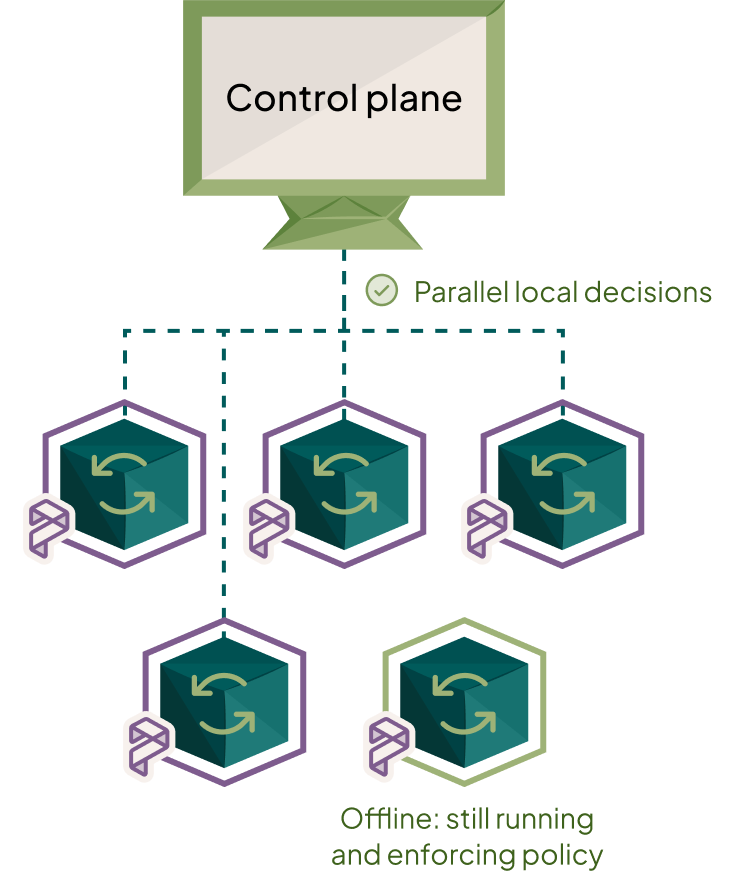
Most platforms funnel every decision through a central brain. Fine at 20 clusters; painful at 200; a liability at 2,000. PaletteAI's architecture is decentralized: management intelligence runs inside each cluster, so policy is enforced locally and upgrades roll out in parallel, over the air.
Lose the link and clusters carry on — enforcing policy, healing failures, running workloads — then resync when the connection returns. It's what makes air-gapped estates and thousand-site edge fleets manageable by a team that also has other jobs to do.
Hub and spoke

PaletteAI: decentralized


Open source at the core, your choices on top
PaletteAI is built on projects your engineers already know — Cluster API, Kairos, KubeVirt, Velero, Prometheus — and stays close to upstream Kubernetes. The catalog is curated, and it's optional: bring your own packs, pin your own versions, drive everything through the API, Terraform, or GitOps. And if you ever walk away, your clusters are still conformant Kubernetes. We'd rather keep you by being good.
A management plan that fits how you operate
Some teams want the management plane run for them. Others need it inside their own four walls, under their own controls — sometimes with no route to the public internet at all. PaletteAI offers a range of deployment and management options to suit, from distributed enterprise fleets to sovereign, air-gapped platforms. Where your control plane lives should be your call.
Security from silicon to token factory
Every layer carries its own protection: immutable OS options and secure boot at the edge, zero-trust identity and access through the platform, SBOM scans that keep your software supply chain auditable — from a company operating under ISO 27001:2022 and SOC 2 Type 2. And when compliance is the mission, PaletteAI VerteX adds FIPS 140-3 validated cryptography at every layer and is GovRAMP Authorized for state and local government: the same platform, hardened for government, defense, and regulated industries.





Enterprise software that behaves like it
A NOC-style console that shows every cluster by location and health. An API that covers everything the UI can do. SLAs, 24x7 support, and services people who've done the migration you're dreading. None of it is glamorous. All of it decides whether year two feels like year one.


See it on your infrastructure
The quickest way to judge PaletteAI is to watch it build your stack in your environment. Book a 1:1 demo with one of our experts.