
Two years ago you could hide your team's AI coding spend in the snack budget. Today, Anthropic's own enterprise figures put typical costs at $150–$250 per developer per month, and heavy agentic use runs $500–$2,000.
At those rates a 50-developer team is spending anywhere from $90K to over $1M a year on tokens.
And the growth curve is scary. Gartner forecasts worldwide AI spending will grow 47% in 2026. Ramp's corporate card data shows enterprise AI bills tripling inside twelve months, a period during which token prices fell 98%. If you're hoping more efficient models will bail you out, GPT-5.6 launched this month claiming a 54% improvement in token efficiency on agentic coding… and yet we'd wager your Q4 bill will go up anyway. Every time tokens get cheaper, teams put the difference into running more of them.
Most of your tokens don't need a frontier model
One response is to ration developer AI use, and some big names are trying it. This summer one of the world's largest software companies reportedly ordered its engineers off their favorite coding agent after bills hit $2,000 per engineer per month and the annual AI budget evaporated by June.
But rationing is self-defeating — the productivity gains of token use should be valuable enough to outweigh any invoice sting.
What if there was a way to keep usage as high as it needs to be, but make each request cheaper?
There is a way: an open model running on your own GPUs takes the everyday work, and a router sends the minority of requests that need frontier-grade reasoning out to a frontier API, under policies your platform team sets. We've made this case at length in our posts on smart model routing and running AI agents as production workloads, so we won't repeat it here.
Most dev-team inference is unglamorous anyway: autocomplete, refactors, test scaffolding, commit summaries. Open models like GLM, Qwen, and Gemma handle that tier of work well, and production routing patterns suggest only 20–35% of requests need a frontier model at all. LMSYS's RouteLLM research found routing could cut costs by around 85% while keeping 95% of GPT-4 quality, and open models have improved a lot since then (just look at the hype around Kimi 3).
Where the Inference Launchpad comes in
The local inference and model routing we just described isn’t something you need to hack together yourself. We’ve done the hard work in our new PaletteAI Inference Launchpad: a turnkey software appliance that runs a strong open model on a single validated GPU server (AMD or NVIDIA) with an intelligent routing proxy and an OpenAI-compatible API.
Your developers keep the IDEs and agents they already use; the only thing they should notice is the absence of a quota warning. Plug it in and it's serving traffic the same day. The product page has the full architecture.
To help you understand the impact of local inference through this Launchpad, we’ve built a TCO calculator for you. Plug in a few numbers, pull the levers as much as you like, and see how the economics work for your business.
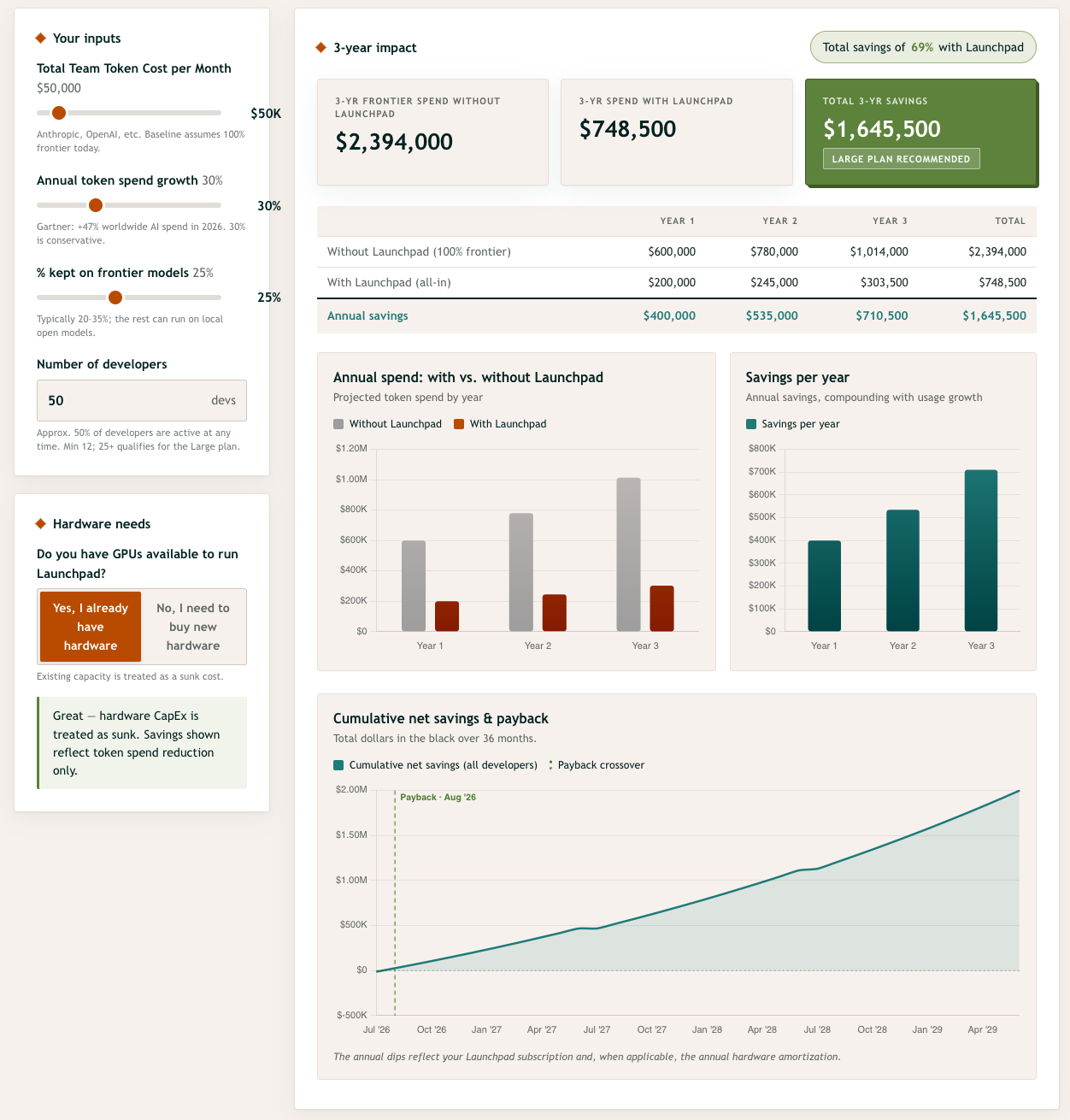
It takes about ninety seconds:
- Set your monthly token spend. Whatever you're currently paying Anthropic, OpenAI, and friends.
- Tell it how many developers you have. This sizes the deployment, since concurrency determines the kit: roughly half your developers are active at any given moment, and above 25 you tip into our larger t-shirt size.
- Pick a growth rate and a frontier share. The defaults are 30% annual growth (conservative next to Gartner's 47% estimate) and 25% of queries staying on frontier models, but you can plug in your own figures if you have them.
- Add hardware costs, if you need them. GPUs already racked? The calculator treats them as sunk and gets on with it. Buying new? Pick AMD or NVIDIA, apply your negotiated discount, choose an amortization period. Defaults are priced against real configurations, such as a Supermicro 8U GPU on the AMD side, without too many nerd knobs. At the time of writing these boxes ship with no lead times.
- Read your results. Three-year totals with and without Launchpad, a yearly breakdown, and a cumulative savings chart with your payback month marked on it.
If you stick with our defaults (50 developers, $50K a month, hardware you already own) the model shows three-year savings just shy of 70%, with break-even inside the first couple of months. That 70% squares with ESG's independent analysis finding that on-premises inference is 2.9–4.1× more cost-effective than API services for sustained workloads, so we don’t think it’s an exaggeration to say that local inference will pay for itself many times over before your hardware amortization period is over.
Of course, not everyone will benefit from the Launchpad. If your team's whole token bill is a few hundred dollars a month, this isn't for you; carry on, your API pricing is fine. And if you have hundreds or thousands of developers, one box won't cover it — you'll want a Launchpad per team, or a conversation about our full PaletteAI platform.
Poke our assumptions, then come talk to us
As you’ll see, every default in the calculator is sourced and adjustable, with the citations sitting right on the page. The growth default leans on Gartner and Stanford HAI; the frontier share comes from production routing studies. Hardware is priced at list, with a slider for whatever discount you've negotiated. We've validated the numbers across our own business and with our partners. We hope even the most distrustful CFO will find the numbers stack up.
The calculator is live at spectrocloud.com/ai-tco. If your numbers come out looking interesting, book a token cost assessment and we'll check them against your real workload profile and negotiated pricing. And if you're at Ai4 in Las Vegas next week, come say hello — all the details are at spectrocloud.com/amd. We'll be the ones with the calculator open!