
National programs get gigawatt campuses, and hobbyists get 7B models on gaming laptops. The enterprises in between have mostly been advised to rent — advice that the economics stopped supporting somewhere in the past year.
AI capital spending carried roughly three-quarters of US GDP growth in the first quarter of 2026, and Gartner now puts worldwide AI spending at $2.59 trillion for the year, up 47%.
Money at that scale dwarfs the great infrastructure projects of the early 20th century, but it has similarities, because here too we’re talking about heavy industry: massive factories, multi-hundred-megawatt campuses that come with their own substations.
Increasingly the buildout is justified in the language of sovereignty, which in practice means control over where data lives and which laws apply when someone comes asking. Gartner expects 65% of governments to have technological sovereignty requirements in place by 2028.
I have no quarrel with any of that; we work with sovereign cloud builders and defense programs every day. My quarrel is with what sovereignty has come to cost everyone else.
Superyacht sovereignty
Most of the sovereign AI proposals I see start from the same shopping list: a hall of GPUs and the MLOps team to run it, plus a facility commitment measured in years. Price it all and the first year runs well into seven figures (before a single useful token comes out). For a defense ministry or a national telco that's a reasonable bill, because national capability has always cost about this much.
The trouble is that a mid-size bank, for example, has a similar jurisdiction requirement as the ministry, and so does a manufacturer with process IP it would rather not donate to a model vendor's training pipeline. Their regulators read the same headlines and their boards ask the same questions of the CIO in the spotlight.
So far the AI industry's answer to them has been to rent a frontier API, on the reasoning that they're too small to own anything — which puts their usage on a meter someone else controls. Even the residency guarantees are softer than they look, because a data center in Frankfurt operated by a US-parented company still answers to the US CLOUD Act.
Ironically perhaps, even Microsoft’s Satya Nadella has called out a ‘warning’ to companies using AI that when they pay for token usage, they’re paying twice: with their money, and with their data.
The result is a market split between the largest organizations that can afford to build a private AI factory, and everyone else — who rent by the token and share their data along with it. The middle, where a lot of the real economy sits, finds neither option satisfactory.
The suddenly viable middle
Today’s AI economics reveals that a surprising share of what enterprises put through their models turns out to be routine — classification, extraction, summarization and the like — and for that work a well-chosen small model produces results you'd struggle to tell apart from a frontier model's, at a fraction of the price.
When Intel tested a local-first agent setup against a cloud-only one, cloud token consumption fell by up to 70%. Stanford's Digital Economy Lab, coming at the question from the cost side, found identical tasks varying by over 1.5 million tokens depending on which model happened to be handling them. The frontier model is worth it for the hard problems, but for the everyday it’s the definition of overkill.
There’s a second development: a change in where inference runs. Public cloud fell from 56% to 41% in a single year as the primary venue for production inference, according to Broadcom's Private Cloud Outlook, and a separate survey found that 79% of enterprises had already moved some AI workloads back on-premises. Inference has been coming home for a while. Orgs are comfortable with it.
Combine these two trends: Eight data center GPUs — H200s or MI300Xs — will now serve models that would have needed a machine hall two years ago, and for many organizations that's enough local capacity to carry most day-to-day inference on smaller models.
A box, a gateway, and a policy
So: local inference on a rack-sized footprint can carry a midsize org’s everyday requests, providing AI factory-style sovereignty without the capex buildout.
The key ingredient is a gateway that reads each user request and decides, based on the task and on the sensitivity of the data involved, whether it stays on your hardware or gets escalated to a frontier API. Completing the picture is a stack of ops capabilities that turns a shared box into something a regulated business can operate: tenant isolation and quotas to keep shared capacity fair, and cost attribution for chargeback.
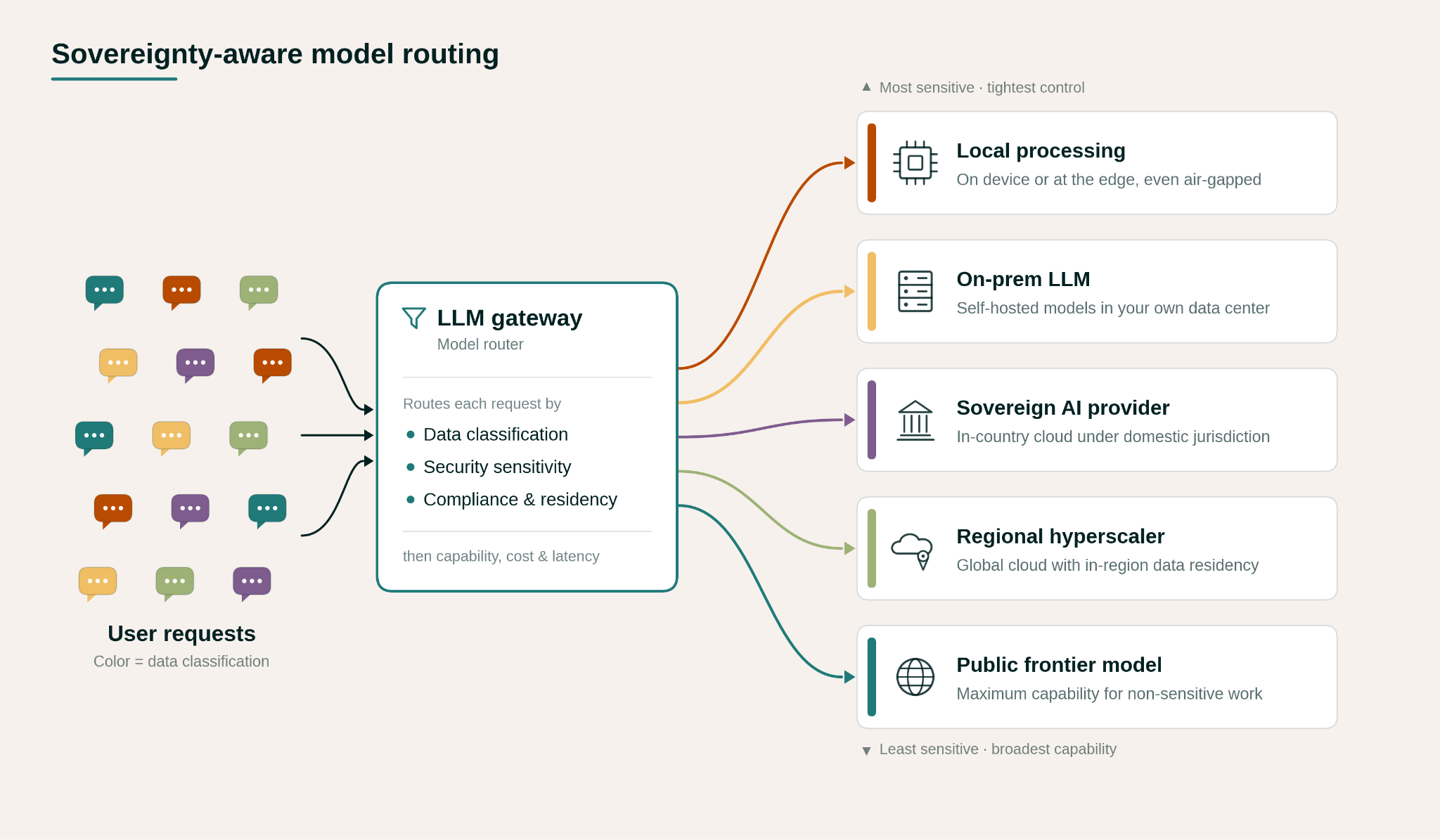
And this whole ops area, while it’s not as sexy as advances in models and hardware density, is dangerously important: 55% of AI costs sit outside the infrastructure itself, in integration, tooling and operations. Sovereignty, for the middle at least, has become an operating model problem more than a capital one.
That's the pattern we built PaletteAI around. It manages the full stack from the metal up to the models, and it treats a frontier API as somewhere you burst to when the task calls for it.
I won't pretend the middle path is effortless. Owning a box means owning model curation and refresh cycles, and taking back capacity decisions that used to be someone else's problem; the frontier will also keep winning the hardest tasks for the foreseeable future, so you'll still be renting some of the time. What changes is the nature of the arrangement. Renting becomes a decision you make per request, on your own terms, and dependency becomes something you can measure, rather than something you discover at contract renewal.
The big ‘superyacht’ buildout will keep making headlines, because three-quarters of GDP growth more or less guarantees it. But that’s OK. A sovereignty program for the missing middle shouldn't need any headlines at all. All it needs is a box, a gateway, and a policy about what leaves the building.
To learn more about where sovereignty programs go wrong at national scale, see Sovereign AI: from policy to production. For the trends shaping enterprise AI this year, read Enterprise AI trends in 2026.