Enterprise AI coding, on infrastructure you own
AMD Instinct™ Coder 355 is a turnkey, on-prem AI coding appliance from Spectro Cloud. This appliance combines the power of AMD Instinct™ 355X GPUs and PaletteAI Inference Launchpad.
Run inference locally on owned hardware for predictable token spend and source code that stays in your environment.

Turnkey and validated
75% cost savings
Up to 95%
85 developers per node*


How much will you save?
Use our Instinct Coder TCO calculator to model your savings versus frontier models — we think you’ll be impressed. It takes seconds and you don’t need to fill in a form.

Rising cost of AI-assisted development
AI coding agents are changing how software gets built. They are also changing how much it costs to build it. Consumption pricing that looks manageable in a pilot project becomes a harsh reality when the same AI project runs in production, across an entire engineering organization. As these coding tools get better, the faster the meter runs.
Consider a 500-developer engineering organization with typical adoption patterns. ~1/3rd of the team is typically made of power users running agent-heavy sessions and multiple concurrent instances at $500 to $1,000+ per developer per month on frontier services. The other 2/3rds are average users at $100 to $250 per developer per month. Together, the annual frontier bill lands somewhere between $1.4M and $3M, and adoption tends to expand from the power users down.
The unit economics of frontier-only AI coding are opex that scales with consumption, with no ceiling. Proprietary source code and internal context leave the organization’s environment with every request. Enterprises are not slowing down AI adoption. They want the productivity without the runaway meter and without their code on someone else's model.
A turnkey AI coding appliance
AMD Instinct™ Coder is a validated, on-prem AI coding appliance built by Spectro Cloud. It gives engineering teams the productivity of frontier AI coding on infrastructure the enterprise owns, with predictable costs. Your prompts or code also stay within your environment.
The appliance integrates with AMD EPYC™ processors, AMD Instinct™ GPUs, AMD Pensando™ networking, and Dell® or Supermicro® AI servers with Spectro Cloud's PaletteAI Inference Launchpad software and the GLM 5.3 coding model.
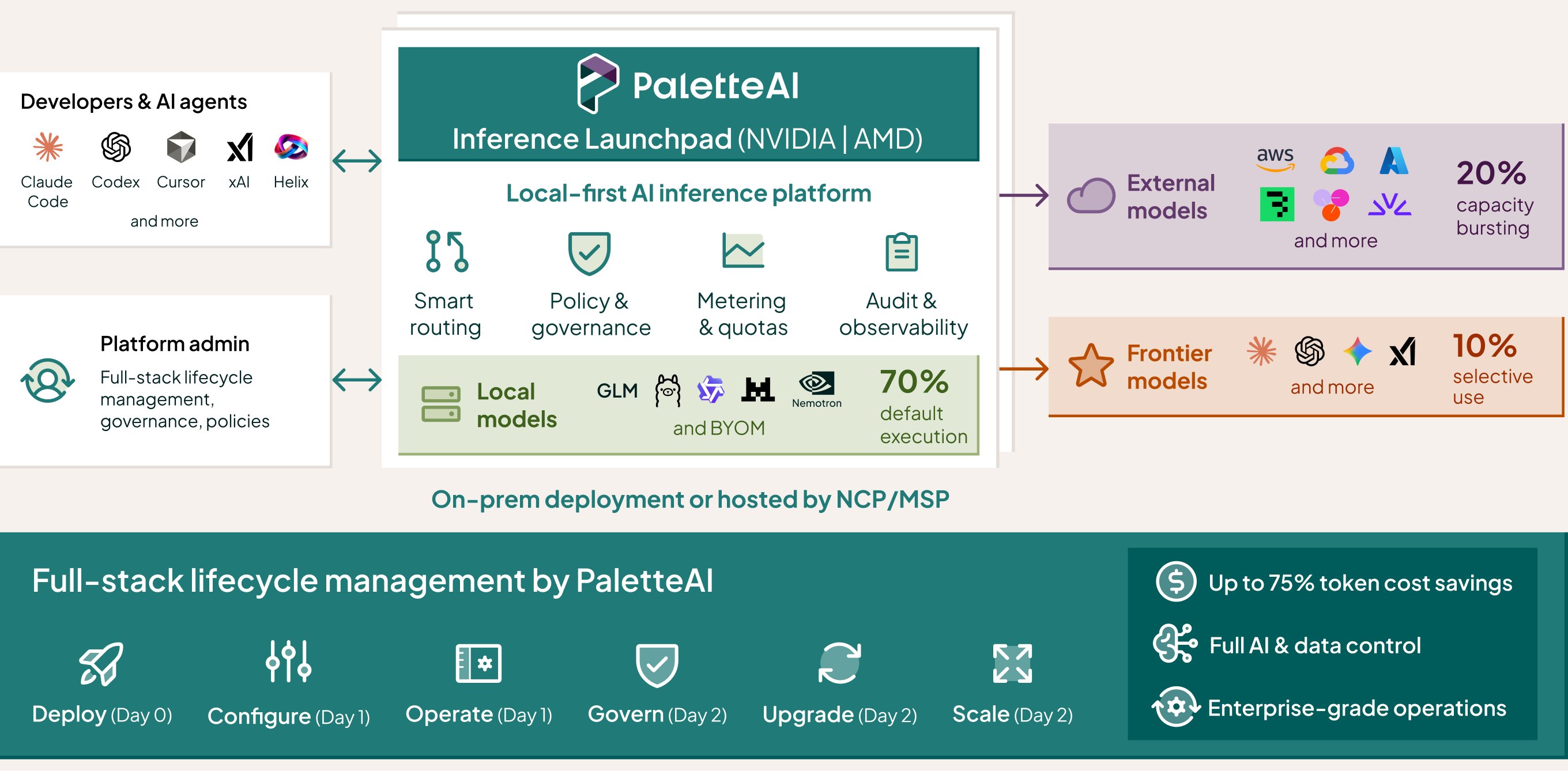
Developers keep the tools they already use (such as Claude Code, Codex, Cursor, Visual Studio Code, etc.) and point them at Instinct Coder the same way they would point at any frontier endpoint. Behind that endpoint, an intelligent router evaluates every request for sensitivity, task, and quota, sends it to a local model on the on-prem GPUs, and falls back to a frontier model only when policy or capability requires it.
Every request is metered and attributed by team, user, and workload. Frontier spend is auditable and comparable side-by-side with local cost in Grafana and Prometheus.
Three primary use cases:
Local-first coding assistance
GLM-5.3 and other open coding models running on on-prem AMD Instinct™ GPUs, served to Claude Code, Cursor, Codex, and Visual Studio Code through standard inference APIs.
Frontier fallback happens under policy
When a request exceeds local model capability or falls inside a sensitivity threshold, the router falls back to Anthropic, OpenAI, Google, or xAI under the rules the platform team defines.
Cost visibility and governance
Token metering, per-team quotas, audit trails, and side-by-side local vs. frontier dashboards for the platform team to see what is being spent, on what, and by whom.
How it works
Instinct Coder ships as a single validated stack. The Dell PowerEdge XE9785 servers or the Supermicro AS-8126GS-TNMR servers house two AMD EPYC™ 9575F CPUs and eight AMD Instinct™ MI355X GPUs.
Spectro Cloud's PaletteAI Inference Launchpad provisions the operating system, Kubernetes cluster, GPU drivers, and inference services from bare metal, and manages the full lifecycle (patching, upgrades, scaling, and observability).
The intelligent router is the software heart of the platform. It sits between developer tools and the models, decides where each request goes based on policy, and meters usage across local and frontier destinations. It runs on standard operating systems and Kubernetes, with no special networking required.
Specifications
Hardware
- 2 x AMD EPYC™ 9575F, 64 cores, 3.3GHz CPUs
- 8 x AMD Instinct™ MI355X
- 3TB (24 x 128GB) DDR5 RDIMM 6400 ECC
- 2 x 960GB NVMe PCIe® Gen4 V6 M.2 with BOSS-N1 controller card
- 8 x 7.68TB PCIe Gen5 TLC U.2 SSD
- 2 x Broadcom 57608 Dual Port 200G (Single Port 400G) QSFP112 adapter, full height PCIe
- 12 x 3200W redundant (6+6 configuration) titanium-level high-efficiency power supplies
Software
- Full-Stack AI lifecycle management
- Enterprise governance at scale
- Intelligent local-first model routing, frontier when justified
- Full visibility and control of AI usage and cost
AI models
- AMD Inference Microservices model GLM-5.3
- Frontier models from Anthropic Claude, OpenAI GPT, Google Gemini (when justified)
Developer tools
Support
- Comprehensive full stack software support from Spectro Cloud
- 3 years next-business-day on site for hardware
Scale

Get started
Ready to retain control over your token spend and maintain data sovereignty without having to endure the GPU waiting period?